
For a business, the most useful starting point is the buying decision. A person asking “Which moving company can handle a two-bedroom apartment move in San Jose with stairs?” is describing a potential job. An answer about the history of moving trucks serves a very different purpose.
At AEOking, we build our approach around those commercial questions. We connect the service page, supporting articles, local information and third-party coverage, then measure what happens. Visibility matters because it can help the right person discover your business. The next steps are helping that person assess the fit and make an inquiry.
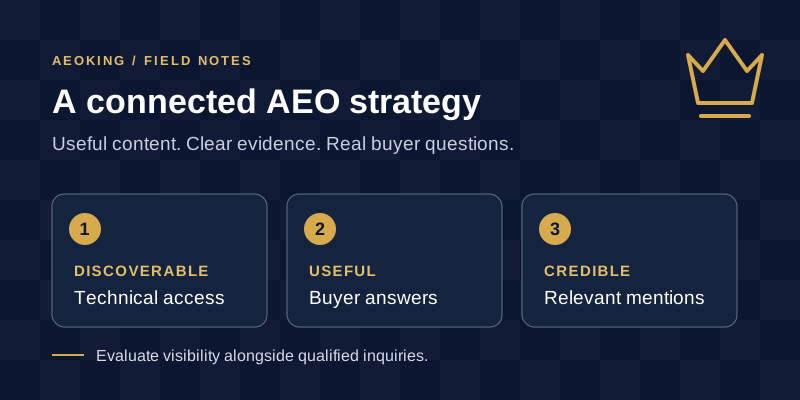
AEO builds on the same foundations as useful search content
There is no special tag that guarantees an AI recommendation. Google says its existing SEO fundamentals also apply to AI Overviews and AI Mode. A supporting page must be indexed and eligible to appear in Search with a snippet, and Google does not require special AI files or dedicated schema. Eligibility does not guarantee inclusion. Source: Google’s guidance on AI features and websites.
That makes the first part of AEO practical website work:
- Make important pages crawlable, indexable and reachable through internal links.
- Explain your services, customers, locations and limitations in plain language.
- Put essential information in accessible text, with useful headings and descriptive links.
- Keep prices, service areas, contact details and business facts current.
- Use appropriate structured data that agrees with the content people can actually see.
Different answer engines have different systems, and their outputs can change. We cannot choose which brand an engine recommends. We can improve the information available about a business and test whether that work is associated with better visibility and more useful visits.
How an answer connects a question to useful sources
When an AI search experience uses the web, it can retrieve relevant pages and use them to help produce an answer. A complex question may prompt several related searches. Google calls this “query fan-out”: its AI features can explore subtopics and data sources when developing a response. Source: Google’s AI optimization guide.
For a business, that creates several possible points of relevance. A service page may explain what you do; an expert article may answer a practical constraint; an independent publication may discuss your experience. These sources need to be accurate and useful on their own. Simply repeating a brand name or forcing an exact question into every heading does not create evidence.
Choose questions that reveal a real purchase decision
Keyword volume can help size a topic, but it cannot tell you everything about its business value. A broad informational phrase may attract people who will never need your service. A much narrower question may describe a customer who is comparing providers today.
We start with the decisions your customers need to make: cost, suitability, location, timing, alternatives and proof. For an illustrative moving-company project, that might include:
- “How much does a two-bedroom move in San Jose cost if there is no elevator?”
- “Which movers can handle packing and temporary storage before delivery?”
- “What should I check before hiring an interstate moving company?”
- “Can I get a written estimate that explains stairs, parking and long-carry charges?”
These are examples of buying questions, not claims about measured search demand. The wording customers use in calls, quote forms and sales conversations helps us develop a more realistic question set.
Next, we give each question a useful home. A service page explains what you sell and how to inquire. A detailed article can explain how an estimate works. A location page can clarify genuine service coverage. Publishing a separate thin page for every wording variation usually adds repetition rather than useful information.
Our AEO services follow that commercial focus: prioritize the services and customers that matter, then build the supporting content and recognition around them.
Audit the gaps between your business and the current answers
A competitor appearing in an answer is a research lead. We look at what the answer says, which sources it cites and whether those sources actually support the recommendation.
A useful audit separates several kinds of gaps:
- Content gaps: Your site never explains a buying factor that the answer discusses, such as minimum booking size or project timelines.
- Evidence gaps: You make a claim about expertise, but provide little supporting detail, methodology or attributable experience.
- Recognition gaps: Relevant industry publications discuss comparable businesses while your brand has little coverage in those places.
- Technical gaps: An important page cannot be indexed, is difficult to reach or buries essential information in inaccessible elements.
- Conversion gaps: Visitors can read the answer but cannot easily request the right service or understand the next step.
We also review the cited page itself. An authoritative-looking domain may host a page that barely relates to your service. Conversely, a smaller specialist publisher may reach exactly the people you want to help.
The resulting plan should explain what to improve and why it matters to the buyer. Copying a competitor’s page or chasing every site that mentions them is unlikely to produce a distinctive, useful resource.
Publish original information that helps someone decide
“Original data” does not have to mean an enormous industry survey. It can be a carefully documented analysis of questions your team regularly answers, provided the underlying records are reliable and you have permission to use them.
For example, a moving business might explain which job characteristics affect its estimates. Useful fields could include property size, travel distance, access conditions, packing requirements, storage needs, booking period and whether the figure is an estimate or final charge. A reader needs the context behind a number to judge whether it applies to them.
If you publish a numerical study, explain:
- What was measured and where the records came from.
- The time period, location and number of observations.
- Which jobs or records were excluded and why.
- Whether figures include taxes, optional services or other charges.
- Important limitations, including whether the findings describe only your own customers.
Those are suggested data fields, not a dataset we are claiming to have collected. Where good data is unavailable, a useful expert explanation is better than an invented statistic.
Google’s people-first content guidance encourages original information, research or analysis and clear sourcing. That supports a sensible content standard, but it does not promise that a particular study will be cited by an AI system. Source: Google’s helpful-content guidance.
Build relevant recognition beyond your own website
Your website is one source of information about your business. Relevant trade publications, local organizations, expert interviews and independently written articles can provide additional context for potential customers.
A backlink connects a publisher’s page to your site. A brand mention can identify your business without linking to it. Either may help a person discover or assess you, but they are different deliverables and should be reported separately.
We evaluate potential coverage by asking practical questions. Does the publisher cover your industry or market? Is the specific article relevant? Can your team contribute something useful? Will the business be described accurately? Would the placement make sense if nobody could see a domain-score metric?
Google describes links as one of the signals used in understanding pages and determining relevance. Its policies also prohibit link schemes intended to manipulate rankings. Paid placements should use appropriate sponsored or nofollow attributes. Sources: Google’s ranking-systems guide and link-spam policies.
That is why our backlink and outreach work distinguishes paid placements from independent editorial coverage. Neither a backlink nor an unlinked mention guarantees an AI recommendation. Relevant recognition is one part of a broader program, alongside the quality of your own content and the underlying service.
Keep local information accurate and useful
For local businesses, the same buyer may encounter a search result, a map listing and an AI-generated answer during one decision. Your service pages and Google Business Profile should give them a consistent understanding of what you do, where you operate and how to contact you.
Google says local results are mainly based on relevance, distance and prominence. Complete business information helps Google understand a business, while distance remains a factor you cannot solve by adding keywords. Reviews and links can contribute to prominence. Source: Google’s local-ranking guidance.
We therefore consider local SEO and Business Profile work where they fit the project. A page about a location should contain genuine service information. It should not suggest you have an office where you do not, or promise that content changes will overcome distance in map results.
For a buyer, useful local detail might include actual service boundaries, access requirements, booking arrangements and examples of the work you can undertake. It also needs a clear way to ask about a particular address or job.
Measure answers, search performance and inquiries separately
AEO reporting becomes more useful when each metric has a clear meaning. We separate three questions:
- Are we appearing? Track an agreed set of buyer questions, recording the engine, date, prompt wording, location context and whether the business was mentioned or a page was cited.
- Are people reaching the website? Review Search Console and analytics for relevant pages and queries, keeping their different definitions in mind.
- Are those visits useful? Where tracking is available and agreed, examine inquiries, qualified leads and completed business rather than assuming a visit became a customer.
Repeated checks help show changes, but a prompt sample is still a sample. It is not a complete measurement of everything every user sees. A brand mention, a cited URL and a recommendation are also distinct outcomes. Our AI prompt monitoring provides a way to track an agreed question set without treating a single screenshot as permanent visibility.
Use the reporting available for the surface you are measuring. Google’s dedicated Generative AI performance report describes impressions from AI Overviews and AI Mode, with page, country, device and date breakdowns. Those impressions are a different measure from website visits or completed inquiries. Source: Google’s Generative AI performance report documentation.
A rise in total organic clicks does not, by itself, identify which clicks came from an AI feature. The client dataset below uses overall Google organic search data, not the dedicated AI report.
Original data: a moving-company client’s Google Search performance
For one anonymized moving-company client, we compared July 1–September 30, 2025 with July 1–September 30, 2026. The dataset contains 184 daily observations: every day in two separate 92-day windows. It does not include the intervening months.
| Metric | 2025 | 2026 | Change |
|---|---|---|---|
| Organic clicks | 2,510 | 3,875 | +1,365 (+54.4%) |
| Search impressions | 969,350 | 2,056,825 | +1,087,475 (+112.2%) |
| Click-through rate | 0.2589% | 0.1884% | −0.0705 percentage points |
| Average position | 34.58 | 29.26 | Improved by 5.32 positions |
Clicks and impressions increased, while CTR declined. A lower average-position number is better. The data does not show universal improvement.
Source: client Google Search Console data retrieved on October 17, 2026 through the GSC Wizard warehouse. The client’s name, website and account identifiers are withheld. The original account report is private; the anonymized daily and summary data are available below.
How the comparison was calculated
- Scope: site-wide Google organic search performance. No country, device, brand or content-group filter was applied. These figures should not be read as US-only or non-branded performance.
- Reporting dates: Google Search Console uses Pacific reporting time (America/Los_Angeles). Each window includes all 92 daily rows, and daily counts sum to the reported period totals.
- Clicks and impressions: recorded search clicks and appearances. Neither is a count of unique people, leads or bookings.
- CTR: clicks divided by impressions, multiplied by 100. The period rate uses period totals, not the mean of daily rates. CSV CTR fields contain percentages.
- Average position: the impression-weighted average topmost position for the property across recorded impressions. It is not click-weighted, a fixed keyword rank or a local-map grid score.
- Changes: absolute change is the 2026 value minus the 2025 value; relative change is (2026 ÷ 2025 − 1) × 100. CTR’s absolute change is expressed in percentage points. We retrieved each year separately rather than using an automatic preceding-period comparison.
- Precision: counts are preserved, daily ratio fields are rounded to six decimal places, and the summary CSV retains source aggregate precision. The table is rounded for readability.
What this evidence can support: Google organic performance changed for this client during the stated windows.
It does not establish AI citations, AI referral traffic, conversions or revenue. It cannot isolate the effect of backlinks, mentions, AEO or any single tactic. Search demand, other marketing, site changes and search-system changes may also affect results; other queries declined during the same period.
A useful case study names the metric, gives the comparison period and lets you inspect the evidence. These downloads provide that context without exposing the client’s identity.
Turn a useful answer into a clear next step
The buying question should determine the next step on the page. Someone comparing moving estimates may need a quote form that asks about size, access and dates. Someone assessing an AEO agency may need to see the scope of work, the reporting method and the limits of any placement commitment.
The first practical step is a suitability audit: identify your most valuable services, examine the questions buyers ask, check your current visibility and choose the gaps worth closing. Then connect content, relevant recognition and measurement to a straightforward inquiry path.
If you want to understand where that work could help your business, talk to AEOking about your priority services and customers. We can discuss the most useful starting point and a scope you can evaluate before committing.
Sources & further reading
Start with the questions your customers ask.
Discuss your priority services, current visibility and the most useful gaps to close.
Talk about your AEO strategy