
For a business comparing providers, the most useful question is what kind of coverage the service can realistically pursue for your expertise. Ask how it selects opportunities, who approves the claims in a pitch and how it distinguishes an earned quotation from a paid placement.
At AEOking, we consider journalist outreach as part of a wider recognition strategy. Relevant coverage can introduce your business to readers and create a third-party reference for your expertise. Its value depends on the actual article, the audience and the contribution, as well as any link.
What HARO link building means today
HARO stands for Help a Reporter Out. Its core purpose is to connect journalists seeking information with sources who can help. HARO is currently operating again under its original name, so older guides that describe it as permanently closed do not reflect the current service. Check the official HARO history and service information when evaluating platform details or subscription options.
“HARO link building” is also used loosely for agency services that respond to journalist requests across multiple platforms. Before hiring anyone, ask which platforms and outreach methods their package actually includes. The name on the package does not tell you whether they monitor HARO, contact journalists directly or arrange sponsored articles.
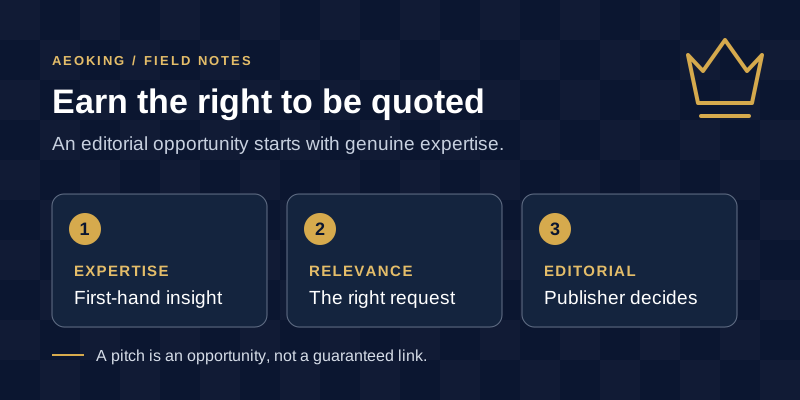
A typical editorial process looks like this:
- A journalist requests expertise relevant to a story.
- An agency checks whether its client is genuinely qualified to contribute.
- The client provides or approves a specific, useful response.
- The agency submits the response within the journalist’s requirements and deadline.
- The publication independently decides whether and how to use it.
The outcome can be a quotation with a link, a quotation without one, a request for more information or no coverage. An agency can control the quality and timeliness of its work. It cannot control an independent editor’s decision.
Begin with relevance, then review the metrics
Domain metrics can provide background, but they cannot tell you whether an individual article will help the right people understand your business. A high-scoring website may publish an irrelevant article. A smaller specialist outlet may have a closer connection to the service you sell.
For each proposed opportunity, ask:
- Does the publication regularly cover our industry, profession or market?
- Does this specific story fit our expert’s genuine experience?
- Will the response give readers useful information they would otherwise miss?
- Is the publication identifiable, with a credible editorial presence?
- Would the coverage still be worthwhile if it included a brand mention but no link?
Suppose a moving-company operator can explain why elevator reservations and parking access affect a relocation plan. That experience could help a property publication write a useful moving checklist. It would not qualify the same person to give investment advice simply because a finance website has an attractive domain metric.
This is an illustrative example of subject fit, not a claim about a placement AEOking has secured. The principle is simple: choose opportunities where your business can make the article better.
Ask how the service develops its expert responses
The quality of the source material matters. A service should be able to explain how it learns about your experience, confirms credentials and obtains approval for statements made in your name.
Before outreach begins, build a usable expert profile. Include the person’s actual role, relevant experience, subjects they can discuss and topics they should decline. Agree on how time-sensitive responses will be reviewed and who can approve them.
A useful response answers the journalist’s question directly. Depending on the request, it might contain a practical explanation, a clearly labeled opinion or an example the expert is authorized to share. Avoid fabricated customer stories, invented statistics and credentials that cannot be verified.
For example, “We always offer the best service” gives a journalist little to use. A qualified operator explaining which details make a moving estimate more accurate contributes something concrete. If the response includes a numerical claim, the agency should know its source and limitations before sending it.
Ask the provider to show its approval process, not just a selection of impressive publication logos. You need to know how it will represent your business when a request arrives at short notice.
Separate independent editorial coverage from paid placements
This is one of the most important distinctions in a proposal.
Independent editorial coverage means the journalist or publisher decides to include the contribution on editorial grounds. Paying an agency for research and pitching does not mean the publisher has agreed to feature you.
A sponsored placement involves payment or another commercial arrangement for publication. It should be represented as sponsored coverage and handled with appropriate disclosure and link attributes.
A brand mention identifies the business. A backlink also points readers to a website. An agency should tell you which outcome it is reporting rather than treating them as interchangeable.
Google asks publishers to qualify paid links using sponsored or nofollow attributes, and its spam policies identify buying links for ranking manipulation as link spam. A provider should be able to explain how its paid placement work follows that distinction. Sources: Google’s outbound-link guidance and link-spam policies.
If a service promises a fixed number of mentions, ask what happens when journalist outreach does not produce them. A disclosed sponsored replacement may be part of the contract, but it should be identified clearly. The fallback, link attributes, publication criteria and any extra cost belong in the written scope.
Review our AEO service plans and your written agreement for the current scope, deliverables and terms.
Compare HARO services using questions you can verify
A “best HARO services” list is only useful if it explains the criteria behind its choices. Instead of relying on a ranking alone, use the same questions with every provider you shortlist.
What work is included in the fee?
Ask whether the price covers opportunity research, expert interviews, response drafting, approvals, submissions, follow-up and reporting. Check any separate subscription fees. A pitch target is different from a publication commitment, and both are different from a guaranteed link.
What counts as a successful placement?
Define whether the deliverable requires the company name, a named expert, a clickable link or a particular type of publication. Ask whether sponsored articles, syndicated copies and existing articles updated with a mention count toward the same total.
What is excluded?
Ask how the provider handles irrelevant stories, prohibited topics, inaccurate credentials, low-quality sites and requests that would reveal confidential information. Declining a poor fit protects your business and makes the campaign more focused.
What can we inspect in the report?
Look for the live article URL, publication date when available, quoted expert, brand attribution, linked destination and sponsorship status. If the service reports link attributes, it should record the actual attributes rather than assume every visible link passes ranking value.
What happens if coverage does not appear or later changes?
Editorial timelines vary, and publishers can revise their pages. Ask about reporting, replacement terms, cancellation and any agreed retention period. Get the policy in writing before comparing headline prices.
These questions help you compare the actual service rather than a set of attractive but differently defined promises.
Understand the cost model and the work you are buying
Providers may charge a monthly retainer, a project fee or an amount per agreed placement. Compare the total scope and definition of a billable result. A cheaper headline price can cover fewer tasks or a different type of coverage. Ask whether expert interviews, revisions, platform subscriptions and any sponsored fallback cost extra, and when payment becomes due.
There is no useful universal price without that context. Get a written proposal you can compare against the same requirements elsewhere.
DIY outreach may suit a team with a qualified expert, time to monitor requests and the ability to respond promptly. An agency may help when opportunity research, coordination and consistent follow-through are the bottleneck. Your expert still needs to supply truthful experience and approve what is said in their name. Hiring a service should make that process easier to manage.
Connect outreach to the buying journey
Coverage works best when it has a useful destination. A relevant article may send readers to your homepage, expert biography, research page or service page. The destination should explain the business accurately and help that visitor continue their evaluation.
If an expert discusses moving estimates, supporting content on your site could explain what an estimate includes and how to request one. If a founder contributes original research, the research page should show its method and limitations. A journalist should be able to check the underlying information without relying on an unsupported promotional claim.
This also connects outreach with answer engine optimization. Relevant third-party information can make more context about your business available online. That is a reason to pursue accurate, useful coverage, not evidence that a particular mention will produce an AI citation.
Google’s guidance says its established SEO practices apply to its AI search features; it does not offer a formula that turns a publisher’s domain score into a guaranteed recommendation. Source: Google’s AI-feature guidance. Our guide to how answer engine optimization works explains how content, recognition and measurement fit together.
Measure the result at several levels
Start with delivery: which qualified opportunities were pursued, which responses were approved and what coverage actually appeared? Then consider the outcome: did relevant readers visit the site, inquire or become customers?
Keep the evidence separate. A published link proves that the link existed when checked. It does not prove that it caused a ranking increase. A brand mention in an article does not establish that an AI engine has read, cited or recommended the business.
Where prompt monitoring is part of the project, track an agreed set of buyer questions consistently and record citations and mentions separately. Our AI prompt monitoring service can support that measurement alongside search and website reporting. Any change still needs interpretation in the context of other work and the limitations of the sample.
The strongest report gives you something you can inspect: the actual coverage, the actual attribution and the next useful action.
Choose a service you can evaluate before you commit
A credible proposal should make its process, editorial limits and commercial terms understandable. It should explain how your expertise fits the publications being pursued, what your team needs to approve and how results will be documented.
At AEOking, we discuss relevant outreach alongside backlink services, useful on-site content and the questions your customers ask before buying. The right mix depends on the business and its existing visibility.
Talk to us about your industry and the customers you want to reach. We can discuss where expert contributions may fit, what a sensible scope looks like and how to assess the coverage that results.
Sources & further reading
Make your expertise useful to the right audience.
Explore where relevant journalist outreach and supporting content could fit your business.
Discuss relevant outreach